


Where Can I Find an Experienced Hiatal Hernia Surgeon in Phoenix, AZ?
When searching for a highly qualified hiatal hernia surgeon in Phoenix, AZ, the board-certified specialists at Phoenix Unified Surgeons offer the clinical excellence you can trust. Our medical team ensures customized surgical care designed to effectively relieve your symptoms, prioritize your safety, and promote a fast, smooth recovery. For more information, contact us or request an appointment online. We are conveniently located at 20333 N 19th Avenue, Ste 230 Phoenix, AZ 85027.
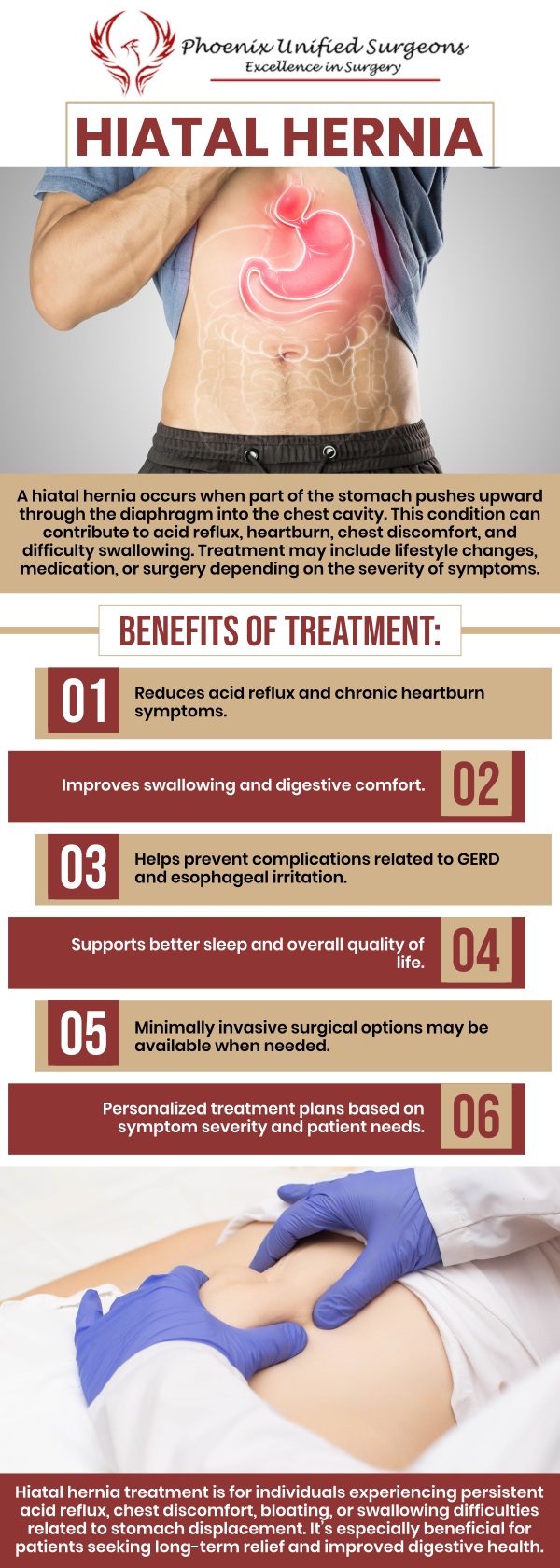
Table of Contents:
What is hiatal hernia surgery, and how does it repair the diaphragm?
When is surgery recommended for a hiatal hernia, and will it relieve severe GERD and acid reflux?
Is hiatal hernia repair performed using minimally invasive or robotic surgical techniques?
What should patients expect during recovery after hiatal hernia surgery?
How do Dr. J. Brian Brizendine, M.D., and Dr. Antonino Cammarata, D.O., at Phoenix Unified Surgeons personalize hiatal hernia care?
At Phoenix Unified Surgeons, our experienced surgical team specializes in the diagnosis and treatment of hiatal hernias—a condition in which part of the stomach pushes upward through the diaphragm and into the chest cavity. The diaphragm is the vital muscle that separates your chest from your abdomen and plays a key role in breathing. Normally, the esophagus passes through an opening in the diaphragm called the hiatus. When this opening becomes weakened or enlarged, it can allow the stomach to herniate upward, causing discomfort and other symptoms.
Our board-certified surgeons are highly skilled in performing hiatal hernia repair. During this procedure, we carefully reposition the stomach back into its proper place within the abdominal cavity. We then repair the weakened area of the diaphragm by tightening the hiatus opening with sutures and, in some cases, reinforcing the repair with a mesh if the opening is large or the tissue is especially weak.
Whenever possible, our team utilizes advanced minimally invasive techniques such as laparoscopic surgery. This approach offers patients several benefits, including smaller incisions, less postoperative discomfort, quicker recovery times, and a reduced risk of complications compared to traditional open surgery.
Hiatal hernia surgery at Phoenix Unified Surgeons is designed not only to correct the anatomical issue but also to alleviate symptoms like heartburn, acid reflux, and chest pain. Our goal is to restore your health and quality of life by providing expert care and long-term solutions to prevent hernia recurrence and related complications. If you are experiencing symptoms of a hiatal hernia or have been diagnosed with this condition, our compassionate team is here to guide you every step of the way—from initial evaluation to full recovery.
At Phoenix Unified Surgeons, our experienced surgical team provides advanced care for patients suffering from hiatal hernias, especially when symptoms are severe and do not respond to medication or lifestyle changes. We are committed to offering the highest standard of surgical intervention for patients in Phoenix and the surrounding areas.
Our surgeons generally recommend surgery for a hiatal hernia when patients experience persistent and severe gastroesophageal reflux disease (GERD) symptoms—such as heartburn and regurgitation—that do not improve with medications like proton pump inhibitors. Surgery may also be necessary if the hernia leads to complications, including:
• Severe esophagitis (inflammation of the esophagus)
• Esophageal stricture (narrowing of the esophagus)
• Chronic bleeding or iron deficiency anemia
• Recurrent aspiration (food or stomach acid entering the lungs)
• Barrett’s esophagus (a precancerous condition of the esophagus)
Additionally, we often recommend surgical intervention for large paraesophageal hernias. In these cases, part of the stomach pushes up beside the esophagus, which can result in symptoms such as chest pain, difficulty swallowing, and shortness of breath. These hernias carry the risk of the stomach becoming trapped (incarcerated) or losing blood supply (strangulation), both of which are surgical emergencies.
At Phoenix Unified Surgeons, we specialize in minimally invasive (laparoscopic) techniques, including the fundoplication procedure. During this surgery, our team wraps the upper part of the stomach around the lower esophagus to reinforce the lower esophageal sphincter and prevent acid reflux. This approach typically results in less pain, a shorter hospital stay, and a quicker recovery for our patients.
Most patients who undergo hiatal hernia surgery at Phoenix Unified Surgeons experience significant improvement or complete resolution of their GERD and acid reflux symptoms—especially when medications have not been effective. While surgery can be highly effective, it is important to understand that, as with any surgical procedure, there are risks and potential complications. Some patients may still require medication or lifestyle adjustments after surgery.
At Phoenix Unified Surgeons, hiatal hernia repair is performed using the latest minimally invasive surgical techniques, including both traditional laparoscopy and robotic-assisted surgery. Our expert surgical team uses specialized instruments and a camera inserted through a few small incisions, which typically results in less postoperative pain, shorter hospital stays, and a faster recovery compared to traditional open surgery.
We are proud to offer robotic-assisted hiatal hernia repair at Phoenix Unified Surgeons. This advanced technique allows our surgeons to control robotic instruments with exceptional precision and dexterity from a specialized console. The enhanced visualization and control provided by the robotic system are particularly beneficial for treating larger or more complex hernias.
The choice between traditional laparoscopic and robotic surgery at Phoenix Unified Surgeons is tailored to each patient. Our experienced surgeons will consider factors such as your overall health, anatomy, and the complexity of your hernia to recommend the most appropriate approach for you.
No matter which minimally invasive technique is used, our primary goals remain the same: to relieve your symptoms, effectively repair the hernia, and minimize the risk of recurrence. At Phoenix Unified Surgeons, you can trust that you are receiving personalized, state-of-the-art care from a dedicated team of specialists.
At Phoenix Unified Surgeons, our team is dedicated to supporting you through every stage of your hiatal hernia surgery and recovery. Understanding what to expect after your procedure can help you prepare and heal more comfortably.
In the days following your surgery with Phoenix Unified Surgeons, it’s normal to experience mild discomfort or pain around the incision sites. Our providers will ensure you have the appropriate pain management plan to keep you comfortable. You might also notice a sore throat or slight hoarseness if a breathing tube was used during your procedure—these symptoms are temporary and should improve as you recover. Some patients experience abdominal swelling or a sensation of fullness while the body heals.
Your care team at Phoenix Unified Surgeons will provide detailed dietary instructions to protect your surgical repair and promote healing. Initially, you’ll start with a liquid or soft food diet and gradually progress to solid foods under our guidance. We recommend eating slowly, taking small bites, and steering clear of foods that may cause bloating or discomfort—such as carbonated beverages. Remaining upright for at least 30 minutes after meals can also help reduce the risk of reflux.
Light walking is encouraged soon after surgery to promote circulation and prevent blood clots. However, you should avoid heavy lifting and strenuous activities until your Phoenix Unified Surgeons provider gives you the all-clear—typically within two to six weeks, depending on your individual progress and the type of surgery performed.
Feeling tired during the early recovery period is common. We encourage you to rest as needed and gradually increase your activity as you’re able. Please keep an eye out for any concerning symptoms, such as increasing pain, fever, difficulty swallowing, persistent nausea or vomiting, chest pain, or signs of infection at your incision site. If you notice any of these issues, contact Phoenix Unified Surgeons promptly for advice or care.
Your follow-up appointments are an important part of your recovery. These visits allow our surgical team to monitor your healing, answer your questions, and make any necessary adjustments to your care plan. Most patients experience substantial relief from their preoperative symptoms, though we may recommend ongoing lifestyle modifications—such as maintaining a healthy weight and avoiding reflux triggers—to support your long-term health.
At Phoenix Unified Surgeons, Dr. J. Brian Brizendine, M.D., and Dr. Antonino Cammarata, D.O., are dedicated to providing exceptional, personalized care for patients with hiatal hernias. The team understands that every patient’s symptoms, health history, and lifestyle are unique. That’s why your care at Phoenix Unified Surgeons begins with a comprehensive evaluation, which may include a physical examination, an in-depth discussion of your symptoms, and advanced diagnostic testing such as endoscopy or imaging studies. This thorough assessment enables the surgeons to accurately determine the type and severity of your hiatal hernia, as well as identify any underlying conditions that may affect your treatment plan.
Throughout your care at Phoenix Unified Surgeons, open communication is a top priority. Dr. Brizendine, Dr. Cammarata, and the entire team are committed to answering your questions and involving you in every decision, ensuring that your care aligns with your personal health goals and needs. By combining cutting-edge surgical expertise with compassionate, individualized attention, Phoenix Unified Surgeons offers the highest standard of hiatal hernia care to every patient. For more information, contact us or request an appointment online. We are conveniently located at 20333 N 19th Avenue, Ste 230 Phoenix, AZ 85027. We serve patients from Phoenix AZ, Sun City AZ, Peoria AZ, Surprise AZ, Glendale AZ, Scottsdale AZ, and surrounding areas.
Check Out Our 5 Star Reviews



Additional Services You May Need
▸ Colon & Rectal Surgery
▸ Gallbladder Surgery
▸ Colonoscopy
▸ Wound Care
▸ Hernia Repair
▸ General Surgery
▸ Robotic and Minimally Invasive Surgery
▸ Appendectomy
▸ Colon Repair/Resection
▸ Lipoma & Cyst Removal
▸ Endoscopy and Colonoscopy
▸ Abdominal Pain
▸ Colon surgery for Diverticulitis
▸ Colon surgery for Colon Cancer
▸ Hemorrhoids
▸ Anal Fistulas
▸ Anal Pain Surgeries
▸ Colostomy Avoidance Surgery
▸ Fecal Incontinence Surgery
▸ Crohn’s Surgery
▸ Ulcerative Colitis Surgery


 Send Text
 How May I Help You?