


When Should You See a Doctor for a Groin Hernia in Phoenix, AZ?
Groin hernia treatment focuses on repairing the weakened area and relieving symptoms such as swelling, pressure, or discomfort in the groin. At Phoenix Unified Surgeons, our board-certified surgeons provide personalized surgical evaluation and advanced hernia repair options, including minimally invasive and robotic techniques when appropriate. For more information, contact us or request an appointment online. We are conveniently located at 20333 N 19th Avenue, Ste 230 Phoenix, AZ 85027.
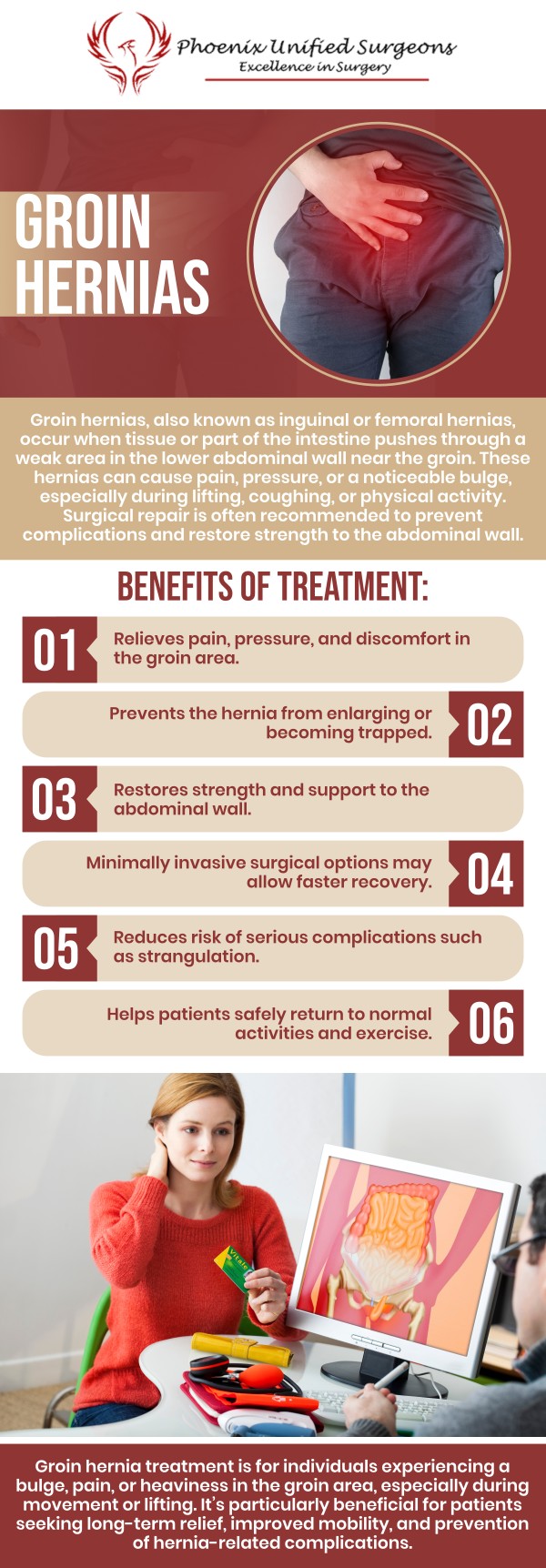
Table of Contents:
What are the common symptoms of a groin hernia?
How can I tell if my groin hernia requires urgent medical attention?
What causes groin hernias to develop?
How is a groin hernia diagnosed by a doctor?
Caring for Your Health: How a Board Certified Surgeon in Phoenix, AZ Helps Manage Groin Hernia Treatment
At Phoenix Unified Surgeons, we frequently diagnose and treat groin hernias, also known as inguinal hernias. Patients often notice a bulge or swelling in the groin area, which may become more prominent when standing, coughing, or straining. Our patients commonly report discomfort or pain at the site of the bulge, especially during physical activity or when lifting heavy objects. This pain can range from a sharp or aching sensation to a feeling of heaviness or dragging in the groin. In men, the hernia may extend into the scrotum, causing additional swelling and discomfort.
While some hernias may present with only mild symptoms, severe or complicated cases can lead to sudden, intense pain, redness, tenderness, and symptoms such as nausea or vomiting. These signs can indicate a strangulated hernia, which is a surgical emergency. If you experience any of these symptoms, we recommend seeking immediate care.
Recognizing when a groin hernia requires urgent medical attention is crucial, as certain symptoms can indicate a serious complication such as strangulation or obstruction.
While many groin hernias cause discomfort or a noticeable bulge that may come and go, it’s important to be alert to specific warning signs. You should seek immediate medical care—either by contacting Phoenix Unified Surgeons or going to the nearest emergency department—if you experience:
• Sudden, severe pain at the site of your hernia
• A bulge that becomes tender, firm, or cannot be pushed back in (reduced)
• Redness or discoloration over the hernia
• Nausea, vomiting, or fever
• Inability to have a bowel movement or pass gas
These symptoms may indicate that part of your intestine is trapped or its blood supply is compromised—a potentially life-threatening emergency that requires prompt treatment.
Groin hernias occur when tissue, often part of the intestine, pushes through a weak spot in the muscles of the lower abdomen or groin. This weakness may be present from birth or may develop over time due to aging, previous surgeries, or injury.
Our experience shows that several factors can increase the risk of developing a groin hernia. Chronic or repeated increases in abdominal pressure—such as heavy lifting, persistent coughing, obesity, or straining during bowel movements—can all contribute to hernia formation. In men, the natural passage of the spermatic cord through the inguinal canal creates an area of vulnerability, making inguinal hernias more common in males. Women may also be at risk, especially during pregnancy, due to increased abdominal pressure.
At Phoenix Unified Surgeons, we understand that untreated hernias can enlarge or lead to potentially serious complications. Our team is dedicated to providing comprehensive care, from initial evaluation through advanced surgical treatment, to effectively address both the anatomical weaknesses and external stresses that lead to hernia development. If you have symptoms or concerns about a groin hernia, our surgeons are here to provide expert guidance and state-of-the-art care tailored to your individual needs.
At Phoenix Unified Surgeons, our experienced team begins the diagnosis of a groin hernia with a comprehensive medical history, carefully listening to your symptoms such as groin pain or noticing a bulge, and asking whether these symptoms change with movement or activity.
During your visit, our surgeons conduct a thorough physical examination of the groin and lower abdomen. You may be asked to stand, cough, or strain—movements that can help reveal a hernia that might otherwise be hidden. By gently inspecting and palpating the area, our specialists can detect any abnormal bulges, especially when the abdominal muscles are under tension.
In cases where the hernia is not easily visible or if there’s uncertainty about the diagnosis, Phoenix Unified Surgeons utilizes advanced imaging techniques, such as ultrasound, CT scan, or MRI, to confirm the presence and type of hernia.
Caring for your health involves making informed decisions, especially when it comes to conditions like groin hernias. At Phoenix Unified Surgeons, our board-certified surgeons in Phoenix, AZ, play a crucial role in the management and treatment of groin hernias, offering both surgical expertise and compassionate care throughout your journey to recovery.
Our board-certified surgeons are highly trained in the latest techniques, including minimally invasive procedures such as laparoscopic hernia repair. These approaches can help minimize postoperative pain and speed up your return to normal activities compared to traditional open surgery.
By choosing Phoenix Unified Surgeons, you are entrusting your care to a team that has met rigorous standards of education, training, and experience. Our expertise, combined with a patient-centered approach, ensures you feel confident and supported as you address your groin hernia and work toward better health.
If you suspect you may have a groin hernia or have been diagnosed and are considering your treatment options, contact Phoenix Unified Surgeons today to schedule a consultation with our experienced team. We are conveniently located at 20333 N 19th Avenue, Ste 230 Phoenix, AZ 85027. We serve patients from Phoenix AZ, Sun City AZ, Peoria AZ, Surprise AZ, Glendale AZ, Scottsdale AZ, and surrounding areas.
Check Out Our 5 Star Reviews



Additional Services You May Need
▸ Colon & Rectal Surgery
▸ Gallbladder Surgery
▸ Colonoscopy
▸ Wound Care
▸ Hernia Repair
▸ General Surgery
▸ Robotic and Minimally Invasive Surgery
▸ Appendectomy
▸ Colon Repair/Resection
▸ Lipoma & Cyst Removal
▸ Endoscopy and Colonoscopy
▸ Abdominal Pain
▸ Colon surgery for Diverticulitis
▸ Colon surgery for Colon Cancer
▸ Hemorrhoids
▸ Anal Fistulas
▸ Anal Pain Surgeries
▸ Colostomy Avoidance Surgery
▸ Fecal Incontinence Surgery
▸ Crohn’s Surgery
▸ Ulcerative Colitis Surgery
▸ TIF Procedure
▸ Colon Fistulas
▸ Groin Hernia
▸ Inguinal Hernias
▸ Hiatal Hernia
▸ Colon-Bladder Fistulas
▸ Colon Diverticulitis
▸ Hiatal Hernia Surgeon
▸ Gastroesophageal Reflux Disease
▸ Colon and Rectal Cancer Surgical Management
▸ Incisional Hernia
▸ Giant Hernias
▸ Skin Cancer
▸ Breast Cancer Screening
▸ Open and Nonhealing Wounds
▸ Incisionless Hiatal Hernia Repair
▸ Lipomas and Common Skin Growths
▸ Surgical Second Opinions
▸ Feeding Tube Access Including PEGs and G Tubes
▸ Upper GI Endoscopy Care
▸ Board-Certified General Surgeons, Colon and Rectal Surgeons
▸ Colon and Rectal Surgeon vs. Gastroenterologist
▸ Colon-Vaginal Fistulas
▸ Port Placements for IV Access
▸ Colostomy Reversal
▸ Abdominal Wall Hernia


 Send Text
 How May I Help You?