


What Should You Expect to Pay for an Endoscopy?
At Phoenix Unified Surgeons, we believe that transparency is the cornerstone of quality healthcare. Under the guidance of Dr. Antonino Cammarata, D.O., our team is dedicated to providing not only clinical excellence in gastroenterology but also clear, honest communication regarding the costs associated with your care. Understanding your financial responsibility allows you to focus on what matters most—your health and recovery. The average cost for an endoscopy ranges from $1,000 to $3,500, depending on the type of procedure, insurance coverage, and other factors. Please contact us or book your appointment online. Our office is conveniently located at 20333 N 19th Avenue, Ste 230 Phoenix, AZ 85027.
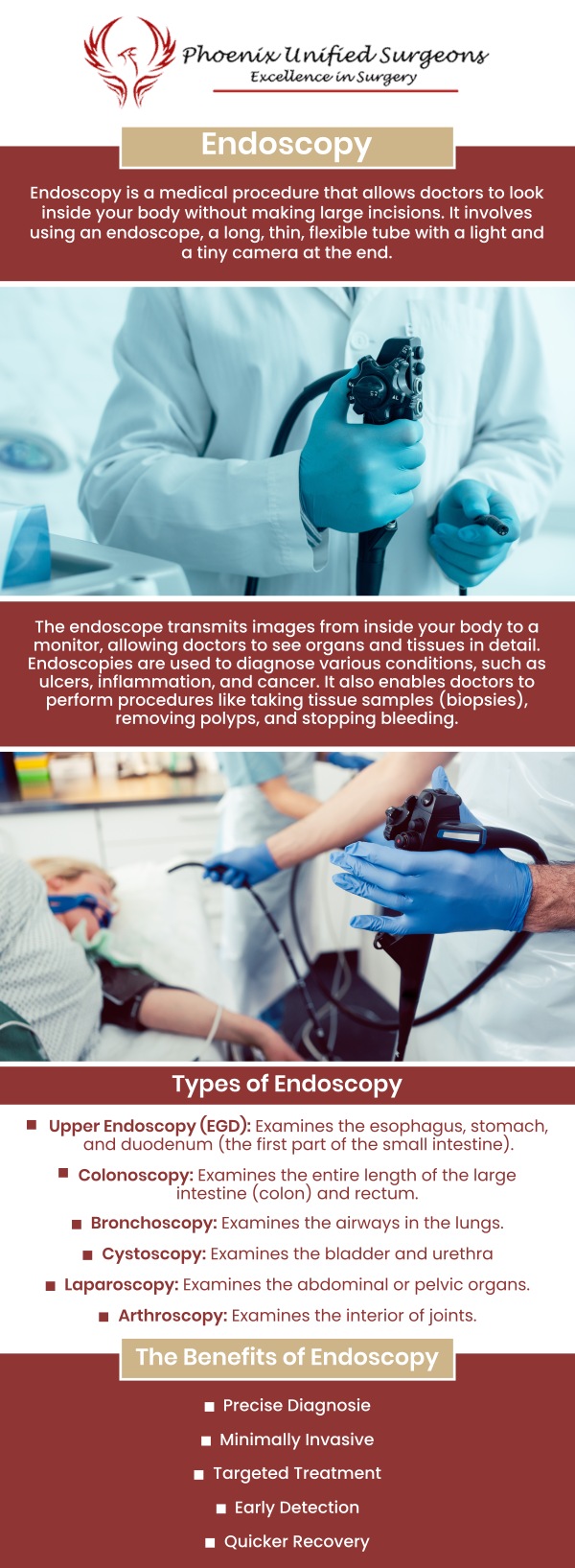
Table of Contents:
How much does an upper GI endoscopy cost without insurance?
Will my health insurance or Medicare cover the cost of my endoscopy?
What is the average out-of-pocket cost for an endoscopy if I haven’t met my deductible?
How can I get an accurate, upfront price estimate for my endoscopy before the procedure?
How Do Costs for an Endoscopy Vary? Dr. Antonino Cammarata, D.O. Breaks It Down
Understanding the Variables
For patients without health insurance, the cost of an upper GI endoscopy (also known as an esophagogastroduodenoscopy or EGD) can vary significantly based on the facility, the geographic location, and the specifics of the procedure. The typical self-pay or cash price for an endoscopy generally falls between $1,000 and $3,500, depending on the facility and specific services involved.
It is important to understand that this total usually consists of three separate fees:
• The Professional Fee: This is the charge for the physician, such as Dr. Antonino Cammarata, D.O., who performs the procedure and interprets the results.
• The Facility Fee: This covers the use of the procedure room, specialized equipment, and nursing staff. Procedures performed in an Ambulatory Surgery Center (ASC) are often significantly less expensive than those performed in a hospital setting.
• The Anesthesia Fee: Most endoscopies involve sedation to ensure patient comfort, which requires the presence of an anesthesia provider.
Additionally, if biopsies are taken or if polyps are removed during the procedure, there will be additional charges for pathology and laboratory analysis. At Phoenix Unified Surgeons, we work closely with self-pay patients to provide clear breakdowns of these costs upfront.
In the vast majority of cases, yes—health insurance and Medicare provide coverage for an endoscopy, provided the procedure is deemed medically necessary. Medical necessity is usually established if you are experiencing symptoms like persistent abdominal pain, difficulty swallowing, chronic heartburn, or unexplained weight loss.
• Private Insurance: Most commercial plans cover endoscopy, but your specific plan will determine your responsibility through co-pays, co-insurance, and deductibles.
• Medicare: Medicare Part B generally covers 80% of the Medicare-approved amount for an endoscopy after you have met your annual deductible. You would be responsible for paying the remaining 20%.
• Screening vs. Diagnostic: It is vital to note that while some procedures (like a screening colonoscopy) are covered at 100% under the Affordable Care Act, an upper endoscopy is almost always classified as “diagnostic,” meaning standard cost-sharing (deductibles and co-insurance) will apply.
If you have a high-deductible health plan (HDHP) and have not yet reached your annual limit, you may be responsible for the bulk of the contracted rate for the procedure. While insurance companies negotiate lower rates with providers than the “sticker price,” the out-of-pocket cost for a patient who hasn’t met their deductible often falls between $1,000 and $2,500.
Once your deductible is met, you typically only pay a small percentage (co-insurance), which might range from 10% to 30% of the remaining cost. We recommend checking your “Explanation of Benefits” (EOB) or contacting your insurance carrier to see exactly how much of your deductible remains before scheduling your appointment at Phoenix Unified Surgeons.
The best way to avoid “surprise billing” is to request a Good Faith Estimate. To get an accurate quote, you will need two pieces of information: the CPT code (the medical code for the procedure) and the name of the facility where the procedure will take place.
At Phoenix Unified Surgeons, our administrative team assists patients by providing the necessary codes and working with insurance providers to estimate your specific out-of-pocket responsibility. You should also call your insurance company’s member services line and ask:
“How much of the deductible is still remaining?”
“What is my co-insurance percentage for diagnostic GI procedures?”
By gathering this data, you can move forward with your procedure with total peace of mind regarding the financial commitment.
Dr. Antonino Cammarata, D.O. is a highly skilled gastroenterologist known for his patient-centered approach and clinical precision. At Phoenix Unified Surgeons, Dr. Cammarata emphasizes that the cost of an endoscopy isn’t just about the procedure itself, but the comprehensive care that surrounds it. He specializes in diagnosing complex GI issues, utilizing advanced endoscopic techniques to identify inflammation, ulcers, or early-stage cancers. By performing procedures in efficient, high-quality settings, Dr. Cammarata ensures that patients receive top-tier diagnostic care while minimizing unnecessary hospital overhead costs, making essential digestive health screenings more accessible to the community.
According to Dr. Antonino Cammarata, D.O., several factors influence the final bill:
• The Setting: A hospital-based endoscopy is almost always more expensive than one performed in a specialized GI clinic or surgery center due to high hospital “facility fees.”
• Geographic Location: Costs in major metropolitan hubs may be higher than in smaller suburban areas due to the cost of living and operational overhead.
• Complexity: A simple diagnostic endoscopy costs less than an interventional one. If the doctor needs to perform a dilation (widening of the esophagus), cauterization to stop bleeding, or extensive biopsies, the complexity—and therefore the price—increases.
• Pathology: Many patients forget the laboratory component. If tissue samples are sent to a pathologist, you will receive a separate bill from the lab for their expert analysis.
Navigating digestive health issues is stressful enough without the added burden of financial uncertainty. At Phoenix Unified Surgeons, we are committed to providing a seamless experience from the initial consultation through the final results of your procedure. Whether you are dealing with chronic acid reflux or need a diagnostic check-up, our team is here to support you with both medical expertise and financial clarity.
Visit Phoenix Unified Surgeons for compassionate, expert gastrointestinal care and transparent pricing tailored to your unique health needs. Please contact us or book your appointment online. Our office is conveniently located at 20333 N 19th Avenue, Ste 230 Phoenix, AZ 85027. We serve patients from Phoenix AZ, Sun City AZ, Peoria AZ, Surprise AZ, Glendale AZ, Scottsdale AZ, and surrounding areas.
Check Out Our 5 Star Reviews



Additional Services You May Need
▸ Colon & Rectal Surgery
▸ Gallbladder Surgery
▸ Colonoscopy
▸ Wound Care
▸ Hernia Repair
▸ General Surgery
▸ Robotic and Minimally Invasive Surgery
▸ Appendectomy
▸ Colon Repair/Resection
▸ Lipoma & Cyst Removal
▸ Endoscopy and Colonoscopy
▸ Abdominal Pain
▸ Colon surgery for Diverticulitis
▸ Colon surgery for Colon Cancer
▸ Hemorrhoids
▸ Anal Fistulas
▸ Anal Pain Surgeries
▸ Colostomy Avoidance Surgery
▸ Fecal Incontinence Surgery
▸ Crohn’s Surgery
▸ Ulcerative Colitis Surgery
▸ TIF Procedure
▸ Colon Fistulas
▸ Groin Hernia
▸ Inguinal Hernias
▸ Hiatal Hernia
▸ Colon-Bladder Fistulas
▸ Colon Diverticulitis
▸ Hiatal Hernia Surgeon
▸ Gastroesophageal Reflux Disease
▸ Colon and Rectal Cancer Surgical Management
▸ Incisional Hernia
▸ Giant Hernias
▸ Skin Cancer
▸ Breast Cancer Screening
▸ Open and Nonhealing Wounds
▸ Incisionless Hiatal Hernia Repair
▸ Lipomas and Common Skin Growths
▸ Surgical Second Opinions
▸ Feeding Tube Access Including PEGs and G Tubes
▸ Upper GI Endoscopy Care
▸ Board-Certified General Surgeons, Colon and Rectal Surgeons
▸ Colon and Rectal Surgeon vs. Gastroenterologist
▸ Colon-Vaginal Fistulas
▸ Port Placements for IV Access
▸ Colostomy Reversal
▸ Abdominal Wall Hernia


 Send Text
 How May I Help You?