


How Can Endoscopy Aid in Early Disease Detection?
Unlock the life-saving potential of preventative care with advanced endoscopy, identifying gastrointestinal issues in their earliest, most treatable stages. Dr. Antonino Cammarata, D.O. utilizes his extensive expertise to perform these minimally invasive screenings, accurately detecting subtle abnormalities like polyps or inflammation before they progress. Prioritize your long-term wellness and gain total peace of mind by trusting your digestive health to our precise, compassionate diagnostics. For more information, contact us or book your appointment online. We are located at 20333 N 19th Avenue, Ste 230 Phoenix, AZ 85027.
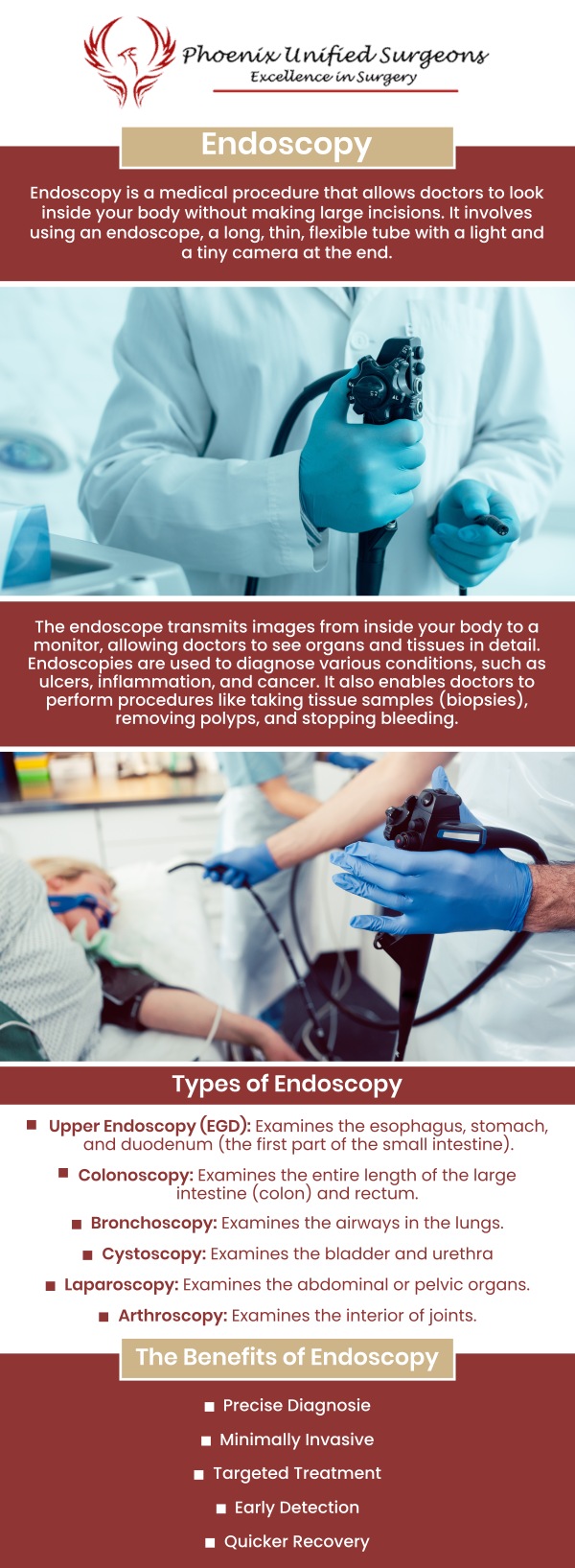
Table of Contents:
What specific conditions can be identified in their pre-symptomatic stages using endoscopy?
Can endoscopy detect pre-cancerous polyps or lesions before they become malignant?
Why is endoscopy often more effective than standard imaging (like X-rays) for early detection?
When should patients without symptoms consider endoscopy as a preventive screening tool?
Early Disease Detection Through Endoscopy with Dr. Antonino Cammarata, D.O., at Phoenix Unified Surgeons
Endoscopic procedures allow our experienced surgeons to directly visualize and evaluate internal organs and tissues, often detecting early-stage conditions before symptoms arise.
Within the gastrointestinal tract, our team utilizes advanced endoscopic techniques to identify pre-cancerous changes such as Barrett’s esophagus—a known precursor to esophageal cancer—and dysplastic polyps in the colon. Through early detection, we can intervene promptly and effectively, significantly reducing cancer risk for our patients.
Our expertise also extends to the early identification of gastric lesions, including intestinal metaplasia and gastric dysplasia, which may progress to gastric cancer. By diagnosing these conditions at a pre-symptomatic stage, we help our patients avoid more complex treatments and improve long-term outcomes.
For patients with chronic liver disease, endoscopy enables our surgeons to detect esophageal varices before any bleeding occurs, facilitating timely management and reducing the risk of serious complications.
Our goal is to leverage the latest endoscopic technology not only for diagnosis but also for minimally invasive treatment, ensuring our patients receive the highest standard of care. Through early detection and intervention, we help improve survival rates, minimize invasive procedures, and support better quality of life for those we serve.
Endoscopy is a highly valuable medical technique that allows our experienced surgeons to visually examine the interior surfaces of the gastrointestinal tract using a flexible tube equipped with a camera.
One of the primary benefits of endoscopy—particularly in procedures such as colonoscopy or upper gastrointestinal endoscopy—is its ability to detect pre-cancerous polyps or lesions before they develop into malignant, or cancerous, growths. Our skilled physicians can directly observe the lining of your esophagus, stomach, colon, or other areas, identifying abnormal tissue changes that may signal the early stages of cancer development. Pre-cancerous polyps, such as adenomatous polyps in the colon, often do not cause symptoms, making their detection during endoscopy crucial for early intervention and cancer prevention.
If these polyps or lesions are found during your endoscopic procedure, our surgeons can often remove them immediately, during the same appointment, greatly reducing your risk of progression to cancer. Endoscopy is considered the gold standard for both detecting and removing pre-cancerous lesions because it not only allows for visual identification, but also enables tissue sampling or biopsy. Our team works closely with pathologists to analyze these samples and determine whether a lesion is benign, pre-cancerous, or malignant.
Endoscopy is a cornerstone of our practice because it offers significant advantages over standard imaging techniques, such as X-rays, for the early detection of gastrointestinal and other internal conditions.
Unlike X-rays, which produce images based on tissue density and can sometimes miss subtle or early-stage abnormalities, endoscopy allows our surgeons to directly visualize the inner surfaces of organs in real time.
Our highly trained surgeons use state-of-the-art endoscopic equipment to provide high-resolution views of mucosal surfaces, enabling the detection of even the smallest or flattest lesions. During an endoscopic procedure at Phoenix Unified Surgeons, we can also take tissue biopsies or perform minor interventions on the spot, ensuring a timely and accurate diagnosis.
While endoscopy is often used to evaluate symptoms, it can also play a vital role in preventive screening for patients who may be at higher risk for certain gastrointestinal diseases—even if they feel well. At Phoenix Unified Surgeons, we follow the latest medical guidelines and take your individual risk factors into account to help you make informed decisions about your health.
Colorectal Cancer Screening:
For adults aged 45 to 50 and older, we recommend starting routine colorectal cancer screening with colonoscopy—a specialized endoscopic procedure—based on national guidelines. Early detection through screening colonoscopy can dramatically improve outcomes and even prevent cancer by identifying and removing polyps before they become malignant.
Family and Genetic Risk Factors:
If you have a family history of digestive tract cancers (such as colon, gastric, or esophageal cancer) or inherited conditions like Lynch syndrome or familial adenomatous polyposis, you may benefit from earlier or more frequent endoscopic screenings. Our team will work closely with you to develop a personalized surveillance plan based on your unique risk profile.
Screening for Esophageal and Gastric Cancer:
Individuals with longstanding gastroesophageal reflux disease (GERD) and additional risk factors—including age over 50, male gender, obesity, a history of smoking, or a family history of esophageal cancer—may be candidates for preventive upper endoscopy (EGD) to screen for conditions like Barrett’s esophagus and esophageal cancer.
Additionally, patients with a family history of gastric cancer, chronic Helicobacter pylori infection, or those from regions with a higher prevalence of stomach cancer may require evaluation with upper endoscopy.
At Phoenix Unified Surgeons, we believe that preventive care should be tailored to each individual. The decision to undergo endoscopic screening without symptoms is based on a careful assessment of your personal risk factors, family history, age, and the latest guidelines from leading medical societies.
Early detection of disease is vital for effective treatment and improved patient outcomes. At Phoenix Unified Surgeons, we are committed to providing the highest standard of care through advanced diagnostic techniques, including state-of-the-art endoscopy. Dr. Antonino Cammarata, D.O., leads our team with specialized expertise in minimally invasive endoscopic procedures, enabling direct visualization of internal organs such as the esophagus, stomach, colon, and more.
Endoscopy is a cornerstone of modern medicine, allowing our providers to identify and diagnose conditions that might be missed by traditional imaging methods. Using a flexible, camera-equipped tube, Dr. Cammarata can detect early signs of gastrointestinal cancers, ulcers, polyps, and inflammatory diseases—often before symptoms become severe. This early intervention frequently leads to less invasive treatments and a significantly higher chance of a full recovery.
Endoscopic evaluations are typically quick, involve minimal discomfort, and require little downtime, making them an ideal choice for both screening and diagnostic purposes. Dr. Cammarata and our team ensure each patient receives not only an accurate diagnosis but also a comprehensive, personalized plan for follow-up care and prevention.
If you have risk factors for gastrointestinal disease or are experiencing persistent symptoms such as unexplained weight loss, abdominal pain, or changes in bowel habits, we encourage you to consult with our experts. For more information, contact us or book your appointment online. We are located at 20333 N 19th Avenue, Ste 230 Phoenix, AZ 85027. We serve patients from Phoenix AZ, Sun City AZ, Peoria AZ, Surprise AZ, Glendale AZ, Scottsdale AZ, and surrounding areas.
Check Out Our 5 Star Reviews



Additional Services You May Need
▸ Colon & Rectal Surgery
▸ Gallbladder Surgery
▸ Colonoscopy
▸ Wound Care
▸ Hernia Repair
▸ General Surgery
▸ Robotic and Minimally Invasive Surgery
▸ Appendectomy
▸ Colon Repair/Resection
▸ Lipoma & Cyst Removal
▸ Endoscopy and Colonoscopy
▸ Abdominal Pain
▸ Colon surgery for Diverticulitis
▸ Colon surgery for Colon Cancer
▸ Hemorrhoids
▸ Anal Fistulas
▸ Anal Pain Surgeries
▸ Colostomy Avoidance Surgery
▸ Fecal Incontinence Surgery
▸ Crohn’s Surgery
▸ Ulcerative Colitis Surgery
▸ TIF Procedure
▸ Colon Fistulas
▸ Groin Hernia
▸ Inguinal Hernias
▸ Hiatal Hernia
▸ Colon-Bladder Fistulas
▸ Colon Diverticulitis
▸ Hiatal Hernia Surgeon
▸ Gastroesophageal Reflux Disease
▸ Colon and Rectal Cancer Surgical Management
▸ Incisional Hernia
▸ Giant Hernias
▸ Skin Cancer
▸ Breast Cancer Screening
▸ Open and Nonhealing Wounds
▸ Incisionless Hiatal Hernia Repair
▸ Lipomas and Common Skin Growths
▸ Surgical Second Opinions
▸ Feeding Tube Access Including PEGs and G Tubes
▸ Upper GI Endoscopy Care
▸ Board-Certified General Surgeons, Colon and Rectal Surgeons
▸ Colon and Rectal Surgeon vs. Gastroenterologist
▸ Colon-Vaginal Fistulas
▸ Port Placements for IV Access
▸ Colostomy Reversal
▸ Abdominal Wall Hernia


 Send Text
 How May I Help You?